







Capability Comparison: Rules-Based vs Intelligence-Driven Planning
While Netstock’s AI-assisted forecasting functionality remains largely rules-based — focused on basic demand modelling rather than integrated, constraint-aware planning.
Algo takes this further. Its AI is designed to connect demand, supply, and financial data in one continuous model, turning forecasts into financially aligned buy plans.
Here’s how the two tools differ when it comes to forecasting depth, financial alignment, and planning intelligence.
| Capability | Netstock | Algo |
|---|---|---|
| Allocation & replenishment | ✅ Rules-based | ✅ Automated + Scenario-aware |
| Demand forecasting | ⚙️ Foundational | ✅ Advanced (AI/ML + promotions, seasonality, NPIs) |
| Constraint modelling | ⚙️ Basic | ✅ Multi-layered (MOQs, lead times, cash, capacity) |
| Financial integration | ❌ Limited | ✅ Full alignment with finance + working capital |
| Scenario planning | ❌ | ✅ Built-in simulations for “what-if” decisions |
When to Move from Allocation to Intelligence
Many teams start with Netstock because it solves an immediate problem: getting stock in the right place. But as complexity grows — from short lifecycle or high-value items to constantly promoted categories or sporadic sales patterns — those rules-based systems begin to strain. Growth only adds more SKUs, channels, and moving parts. That’s when businesses move to Algo for planning that looks upstream and connects every decision back to demand and cash flow.
Netstock
- Smaller distributors or retailers
- Teams needing simple replenishment rules
- Organizations with fewer SKUs or stable demand patterns
Algo
- Mid-market to enterprise retailers and distributors
- Businesses managing complex SKUs, promotions, and seasonality
- Teams facing supply or capacity constraints
- Finance teams seeking tighter alignment between inventory and working capital
Cost & ROI Considerations
Netstock: Lower cost, limited visibility
Netstock’s strength lies in its simplicity and price point. For smaller businesses, the low licence cost and quick setup make it an attractive way to automate replenishment. But the trade-off shows up downstream — when excess inventory ties up cash, promotions aren’t forecasted accurately, or service levels plateau. The trade-off appears when visibility ends at the warehouse — not at the balance sheet.
Without upstream visibility into demand, supplier constraints, and financial alignment, teams can end up reacting to stock imbalances rather than preventing them. Over time, that reactivity costs more than the software licence itself — through margin leakage, stockouts, and working capital locked in slow-moving inventory.

Algo: Higher capability, measurable return
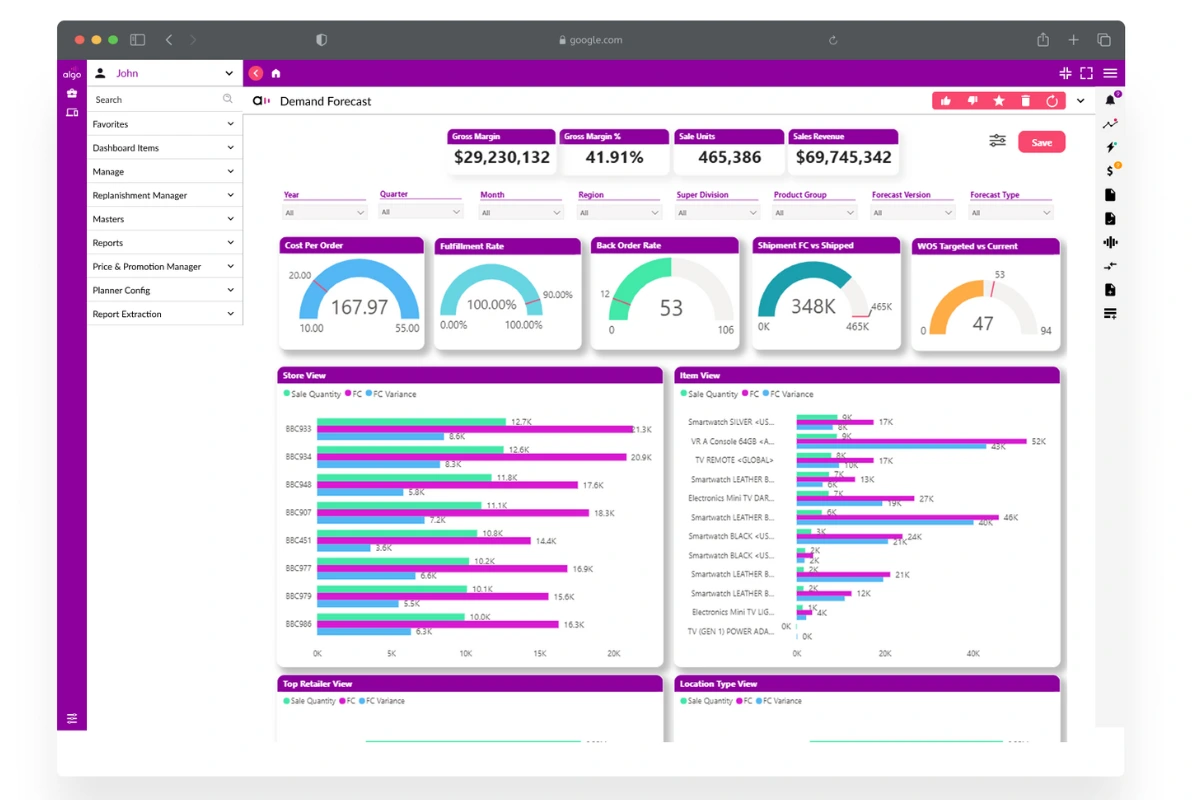
Algo represents a larger investment but one that pays back quickly through measurable financial outcomes. It’s designed for organizations ready to move from allocation to full planning, where every decision — what to buy, when, and why — is data-driven and financially aligned.
Algo’s ROI comes from alignment — every plan serves both the shelf and the CFO.
By combining advanced forecasting with constraint-aware planning and scenario modelling, Algo helps businesses improve service while reducing excess and freeing up capital.
Across implementations, Algo typically delivers:
- 2–4 points of margin improvement through smarter buys and fewer stockouts
- 10–20% reduction in excess inventory by aligning buys with true demand
- Faster cash recovery through better GMROI and working capital optimization
Migration Path: From Netstock to Algo
Switching from allocation-only to end-to-end planning doesn’t mean starting from scratch. In fact, most teams already have the foundation in place — they just need to layer Algo’s planning intelligence on top of their existing replenishment process.
Algo’s onboarding is designed to be collaborative, transparent, and low-risk. Instead of replacing Netstock, Algo integrates with your current workflows to add the upstream visibility that allocation alone can’t provide.
Here’s how a typical 90-day migration unfolds:
0–30 Days: Data Audit & Forecast Rebuild
The first step is connecting your data and rebuilding your forecast models. Algo’s team helps validate master data, review historical demand, and identify where existing rules may be driving inefficiency — such as overstated safety stocks or reactive reorder points.
- Data health check (SKUs, locations, lead times, constraints)
- Forecast alignment workshop
- Baseline accuracy and bias assessment
31–60 Days: Constraint Modelling & Scenario Setup
Next, the focus shifts to making the plan real. Algo’s planning engine incorporates supplier lead times, MOQs, capacity limits, and working capital targets — producing scenarios that show how different buying strategies affect service and cash.
- Configure constraints and policy drivers
- Run “what-if” scenarios to model impacts
- Align inventory targets with finance and operations
61–90 Days: Buy Plan Integration & Allocation Hand-off
Once the buy plans are approved, Algo connects directly with your allocation tool — handing off replenishment recommendations for execution. You maintain your familiar Netstock workflows, now powered by a smarter upstream plan.
- Seamless API or CSV integration with your allocation system.
- Plan validation and cross-functional sign-off
- Transition to ongoing performance monitoring and optimization
Think beyond replenishment. Predict with precision. Drive strategic growth. Request an Algo demo today.
Trusted by global supply chain teams — reviewed on